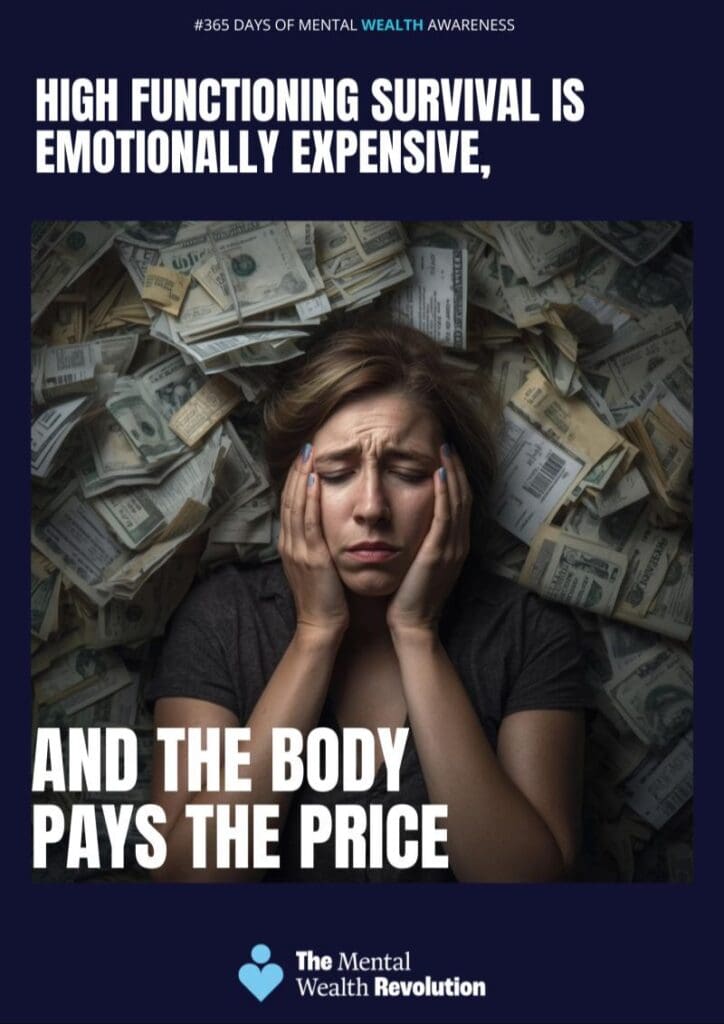
The body is keeping its own accounts.
Yesterday I posted about my quiet withdrawal at the end of 2025, and my self reflection on high functioning survival traits. There’s another layer to all of this that I’ve been sitting with, and the phrase that’s circling in my mind is ’emotional economics’. I didn’t go looking for it. It just appeared, as these things often do when you’re trying to make sense of something that’s been happening beneath the surface.
What I mean by it isn’t academic or theoretical. It’s very real and very human.
When you’re high functioning, capable, and used to carrying a lot, it’s surprisingly easy to start living on emotional and nervous system credit. You tell yourself you’ll deal with things later. When this season eases. When there’s more space. When life calms down a bit.
So you override the signals. You park the feelings. You borrow energy from tomorrow to get through today. Not because you don’t know what you’re doing. Often you’re fully aware. You just trust yourself to cope. And for a while, that trust feels justified. The work still gets done. The people are supported. The responsibilities are met. From the outside, it looks like competence, resilience, even strength.
I’ve been thinking a lot about the idea of body budgeting, something Lisa Feldman Barrett speaks about in her work. The nervous system is constantly managing resources, predicting demands, and trying to keep us within a sustainable range of energy and capacity.
The thing is, there’s no immediate alert when you overspend. No clear moment where you’re told you’ve gone too far. You just keep withdrawing from the same account and assuming you’ll pay it back later. And later feels harmless. Neutral. Like it will take care of itself.
Except it doesn’t. Interest accumulates quietly.
And eventually the cost shows up. Sometimes as exhaustion that rest doesn’t quite touch. Sometimes as anxiety that feels bigger than the situation in front of you. Sometimes as a dull loss of joy or clarity. Sometimes simply as the sense that you’re no longer fully at the wheel of your own life.
What I’m seeing much more clearly now is that high functioning survival isn’t usually about falling apart. It’s about deferring the cost. We assume that being capable somehow cancels out consequence. It doesn’t. It just delays the moment when the body asks for repayment.
So, the question I’m holding now isn’t whether I can cope. It’s what I might be quietly putting on credit, assuming I will deal with the cost later.
That realisation has shifted how I understand stress, resilience, and what high functioning actually means. Because being capable doesn’t make the cost disappear. It just moves it into the future. And at some point, the body stops extending credit and the bill lands where it always does, in the body.